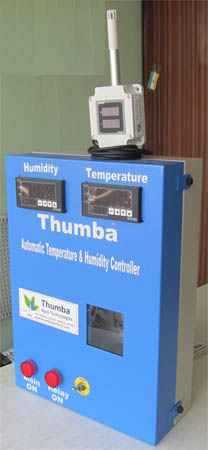
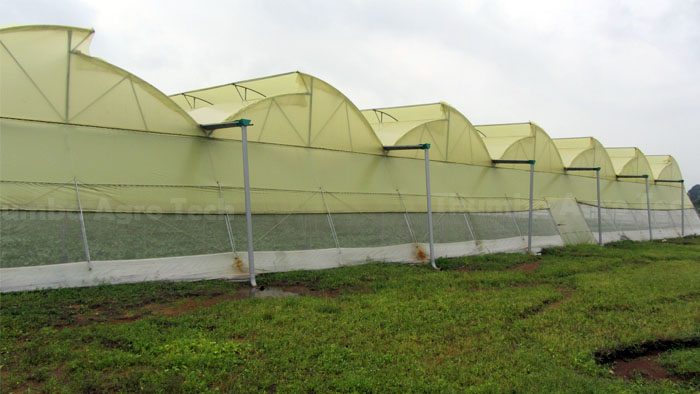
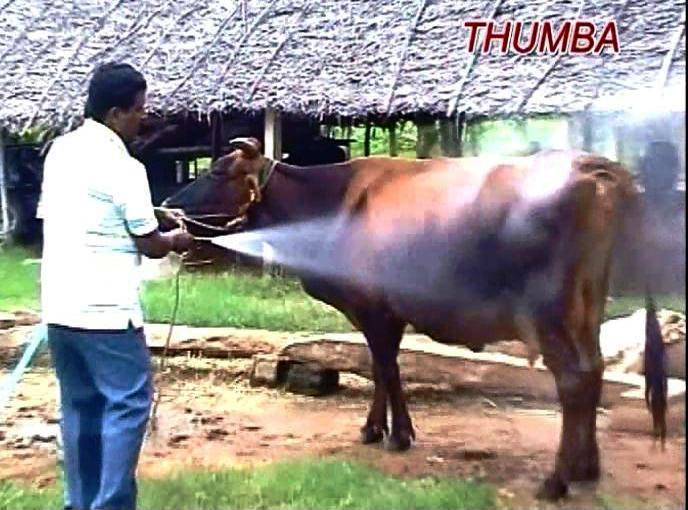
Mulberry cultivation — the leaf supply behind every rearing crop. We take on full sericulture RainGun irrigation projects for better quality clean leaf without impurities, as well as shed climate.
Sericulture farming is an important part of modern agriculture in India. More than 90% of mulberry cultivation is practiced in Karnataka, Andhra Pradesh and Tamil Nadu. During hot summer days, special care is required to maintain yield and silk quality.
The ideal rearing temperature is 24°C to 28°C with relative humidity of 80% to 85%. Without proper climate control, high summer temperatures can severely reduce silkworm health, silk quality, and farm income.
We offer two proven climate control methods for sericulture sheds:
Our E-Coolers use evaporative cooling to reduce shed temperature from 36°C down to 28°C and control relative humidity from 25% to 85% with proper shed insulation. Power consumption is only 200W × 2 units for a 60 × 22 feet shed. Manual or automatic timer control is available.
Suited for very high temperature zones of 38°C to 47°C. Atomizer nozzles bring temperature close to 28°C and RH to 75% without any wetting or fungus problems — ideal for extreme summer conditions in Karnataka and Andhra Pradesh. But this facility is not needed in Tamil Nadu regions — there, the evaporative E-Cooler concept alone is enough.
| 1. Power Consumption | : | 200 W × 2 units |
| 2. Coverage Area | : | 60 × 22 feet shed |
| 3. Temperature Reduction | : | 36°C → 28°C |
| 4. Humidity Control | : | 25% to 85% RH |
| 5. Control Type | : | Manual or Automatic Timer |
| 6. Power Supply | : | Single Phase AC |
| 1. Suitable For | : | 38°C to 47°C ambient zones |
| 2. Achievable Temperature | : | ~28°C |
| 3. Achievable RH | : | ~75% |
| 4. Wetting Risk | : | None |
| 5. Fungus Risk | : | None |
Our sericulture work rests on two things: practical experience rearing silkworms on our own farms, and formal cooling engineering training.
In 1996 our founder completed a six-month full-time onsite practical and engineering course in Air Conditioning Engineering at Nachimuthu Polytechnic, Pollachi, Tamil Nadu — taught by the Canadian professor Dr. Daniel Lee Daigle, a well-known cooling project designer. The training was full-time theory and practical design work inside working factories — milk chilling plants, mushroom units and commercial cooling projects.
That is what pushed us into designing custom-made cooling projects across sectors — mushroom farming, sericulture shed cooling, textile mill humidity control, residential coolers and dairy animal shed cooling.
For sericulture shed cooling specifically we developed an entirely different E-Cooling concept using the forced circulation method. It was designed against all the factors that actually decide a rearing crop: high temperature control, low humidity, carbon dioxide removal, and fully automatic controllers for accurate control. It also eliminates the salt sediment problem in honeycomb pads — we use only special wood wool, for longer life and better performance than the alternatives.
We have updated every existing sericulture shed cooling concept with our own Thumba Model. At base it is still an evaporative cooling system — but the operating method is entirely different from the technologies currently sold in this market. Here is exactly how the two differ, point by point.

A Thumba E-Cooler mounted on its own raised stand against the shed wall. The brown panels are the special wood wool we use in place of honeycomb cooling pads — the single change that removes the salt sediment problem and lets the system run on borewell water up to 1,000 TDS without blocking.
Mounting it outside on a stand keeps the unit clear of the rearing floor and needs only a 20 inch hole through the wall — against the 5 ft × 4 ft opening a cooling pad bank requires. Points 1, 2 and 5 in the table below are what this photo is showing.
| Features | Thumba's E-Cooling Concept | Currently Market Available Honeycomb Pad Concept |
|---|---|---|
| 1. Maintenance | No such maintenance comes up at all. No cleaning required. | Cleaning and periodical service required. Pad replacement is much costlier. |
| 2. Water Quality | Salt water up to 1,000 TDS is not a big issue — you can use whatever borewell water you already have. | Immediate blockage occurs with salty water. If it is not cleaned, cooling effect drops. A major issue. |
| 3. Air Circulation | Forced air circulation, so no air-tight shed is needed — just some opening to push the hot air out. | Sucking air concept — the shed must be air tight or circulation is not possible. Insulating every area is a big practical problem. |
| 4. CO2 Removal | Forced circulation pushes carbon dioxide out through holes provided in the bottom shed walls. | No such facility is possible with the sucking concept. CO2 stays at floor level and affects worm health. |
| 5. Installation Opening | A very small hole of 20 inches diameter is enough to install our E-Coolers — 2 or 3 units for a 1,200 sq ft shed. | Needs a minimum of 5 ft height × 4 ft width for pad installation, and 2 sets for the same area. |
| 6. Power & Backup | Only 400 W to run. A normal 1 KVA UPS with a single 150 AH battery carries you through a full day's power cut. | UPS running costs far more — 4 × 150 AH batteries for one day of backup. |
| 7. Solar Option | A 1 kW solar system is an additional option, and a much better facility. See our solar systems. | Solar for this setup is very costly — not feasible. |
| 8. Automation | Full automation — time based, temperature and humidity sensor based, or manual. We can switch off 50% of power usage when it is not needed. | Automation is possible, but fan motor and water pump power cannot be reduced. Only full running or full stop. |
| 9. Serviceability | User friendly and user serviceable. You do not need our technicians — the owner can do any service on the system. No permanent dependence on service staff. | Complicated electronic controller circuits mean the user cannot rectify electrical or electronic parts. |
| 10. Cooling Uniformity | Uniform cooling across every part of the shed thanks to forced circulation. Only the hot air leaves, through vents at the top of the shed. | Irregular — over-cooling at the pad-mounted end and up to 50% less cooling at the opposite corners. Cooled air is also pulled out unnecessarily. |
This is the most important point in the whole design. Every machine is built with standby support from every angle. If one E-Cooler stops working for any reason, the other is already in action — so the cooling effect is never lost. The controller carries the same provision: if a sensor develops a problem, you switch over and run the system manually.
We reared silkworms on our own farm from 2004 to 2009, and learnt this the hard way: even a continuous two-hour failure of shed cooling will affect silkworm health through heat stroke. On a hot summer day a cooling system you cannot trust is worse than no plan at all — which is why worm health and good yield depend on the standby design above.
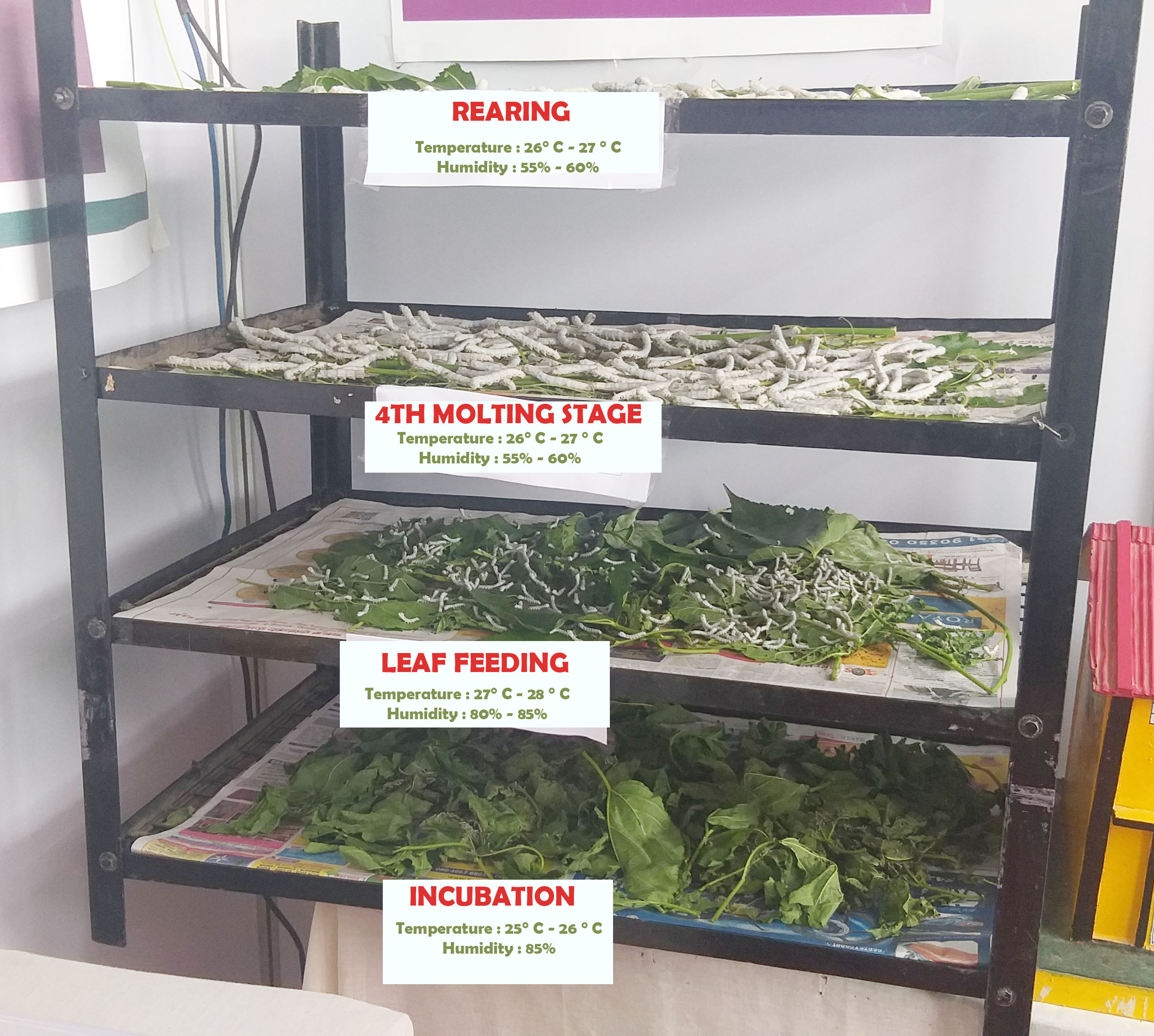
The correct temperature and humidity for each stage of the worm's life cycle is set out in the stage chart above — incubation and brushing, quality leaf feeding, molting, and the spinning stage after the fourth molt.

What the whole system is for — a harvest of clean, uniform cocoons. Holding the shed at the right temperature and humidity through all 26 to 27 days is what protects both the yield and the silk quality.
Temperature and humidity control does not begin with the cooler. It begins with shed design and the materials used to build it. We give complete shed plans with air flow provisions and proper insulation design — deliberately simple and economical, but efficient.
We also take on big sericulture projects end to end: mulberry cultivation with an advanced RainGun irrigation system together with climate control for the rearing sheds. If you are planning a new shed, talk to us before construction starts — it costs far less to design the airflow in than to fix it afterwards.
Ideal temperature is 24°C to 28°C with relative humidity of 80% to 85%. During molting, 65–75% RH is optimal. During incubation and brushing, maintain 25–26°C and 85% RH. During the spinning stage (after 4th molt), maintain 26–27°C and 55–60% RH.
E-Coolers use evaporative cooling to reduce shed temperature from 36°C down to 28°C and control relative humidity from 25% to 85% with proper shed insulation. Power consumption is only 200W × 2 units for a 60 × 22 feet shed. Manual or automatic timer control is available.
E-Coolers are suited for standard temperature zones (reducing to 28°C) and are energy-efficient at 200W. Atomizer nozzles are suited for very high temperature zones (38°C to 47°C) and bring temperature close to 28°C and RH to 75% without any wetting or fungus problems.
More than 90% of mulberry cultivation in India is in Karnataka, Andhra Pradesh and Tamil Nadu. These states experience high summer temperatures that can severely impact silkworm health and silk quality without proper cooling systems.
The entire rearing process from brushing to spinning takes 26 to 27 days. Maintaining correct temperature and humidity throughout each stage — incubation, feeding, molting, and spinning — is critical for maximum yield and cocoon quality.
Yes. Share your shed dimensions, location, and the number of rearing beds with us. We will recommend the right combination of E-Coolers and/or atomizer nozzles and provide a quotation within 24 hours. Call or WhatsApp +91 98433 35703.
Yes. With our E-Cooler concept, salt water up to 1,000 TDS is not a big issue — you can use whatever borewell water is already available to you. Conventional cooling pad systems block immediately on salty water, and if the pads are not cleaned the cooling effect drops badly. We also use only special wood wool instead of honeycomb pads, which is what eliminates the salt sediment problem and gives longer life.
Our E-Coolers need only 400 W in total, so a normal 1 KVA UPS with a single 150 AH battery will carry a shed through a full day's power cut. A cooling pad system needs four 150 AH batteries for the same backup. A 1 kW solar system is available as an additional option. This matters more in sericulture than in most sectors: even a continuous two-hour failure of shed cooling will affect silkworm health through heat stroke.
Nothing stops. Every machine is designed with standby support — if one E-Cooler is not functioning for any reason, the other is already in action, so the cooling effect is not lost. The controller has the same provision: if a sensor develops a fault, you switch over and run the system manually. The system is also user serviceable, so you are not dependent on our technicians for routine service.
We give complete shed plans with air flow provisions and proper insulation design — simple and economical, but efficient. A good temperature and humidity control system starts with the shed design and the construction materials, not with the cooler. We also take on full sericulture projects: mulberry cultivation with an advanced RainGun irrigation system together with climate control for the rearing sheds.
Tell us your shed size and location — we'll recommend the right system and give you a quote within 24 hours.
More temperature control solutions for farms, sheds, and protected cultivation.
Many sericulture farmers also maintain dairy cattle. Explore our dairy cleaning and feeding solutions.