Mushroom farming is very popular nowadays. But due to El Niño and other climate changes — particularly a rise in temperature — production is affected seasonally. For better growth, Oyster and Milky mushrooms need 24°C to 28°C, and Button mushrooms need 20°C.
In hill stations and tropical rain forest areas the temperature always stays low — 0°C to 24°C max — so you can grow button mushrooms there naturally. But in plain areas, temperature can go up to 20°C to 42°C across various seasons. Here, mushrooms need 22°C to 28°C room temperature for better growth and yield.
Our mushroom farm climate control system works on the evaporative cooling method, which is entirely different from normal high-power-consuming air conditioners. Only water is used to cool the area. When water evaporates at a low temperature it absorbs heat from the atmosphere. That, simply, is the working method.
We have developed two different cooling methods for mushroom farms, matched to how hot your area gets.
Evaporative coolers are very effective machines for cooling mushroom sheds in tropical areas where the temperature rises from 28°C to 41°C and humidity comes down to 25% on summer days. They successfully control 26°C to 30°C and 65% to 95% RH with comparatively very minimum power usage.
If you use air conditioners for the same application, the temperature may be controlled, but the AC absorbs the humidity and removes the water content inside the shed, which affects the growth of the mushrooms. An AC also needs around 8 times more power.
| Suits areas | : | 28°C to 41°C, RH down to 25% |
| Controls | : | 26°C to 30°C, 65% to 95% RH |
| Unit capacity | : | 200 and 500 Sq. Feet |
| Unit power | : | 90W and 180W |
| Electricity | : | Single Phase 220V |
| Water | : | Below 1,000 TDS |
This is high level engineering in cooling concepts. For 100% successful cooling in hot areas where the temperature rises to 37°C–47°C on summer days, this system is essential.
It works on the fine misting concept. Water passes through high pressure misting nozzles to produce a fine mist of approximately 10 microns. The mist particles mix with the atmosphere inside the shed and cool the area within a few seconds. You can raise relative humidity from 20% to 95% within 5 minutes, so the temperature also falls to a level favourable for mushroom growth, with no climate stress on the crop.
It runs for a very short time: only 2 minutes in every 15 to 30 minutes. A total of 5 HP is enough to run the mist nozzles for a 12,500 sq. ft shed. You can also control, or switch off, a particular area where it is not needed while that section is being prepared for the next batch.
We have designed the complete system from our long experience in cooling concepts and our practical engineering study in various cooling factories:
| Suits areas | : | 37°C to 47°C summers |
| Mist size | : | 10 Microns |
| Coverage | : | 12,500 Sq. Feet on 5 HP; up to 1 Lakh Sq. Feet |
| Pump power | : | 2 to 5 HP, 3-Phase |
| Pressure | : | 35 to 75 Bar |
| Run cycle | : | 2 min every 15–30 min |
| Water | : | RO, below 100 TDS |
| Feature | E-Coolers for Mushroom Shed | Air Conditioners for Mushroom Shed |
|---|---|---|
| Working concept | Evaporative cooling | Refrigerant expansion cooling |
| Power | Very little power. For a 1,000 sq. ft area, 400 W is enough for the coolers. | Huge power consumption. A 1,000 sq. ft area needs at least a 4 ton AC, consuming 6,000 W. |
| Power supply | Single phase is enough: 220V, 1φ, 50Hz | Three phase is a must: 415V, 3φ, 50Hz |
| Investment | Very low initial investment for cooler erection | Big investment needed for AC erection |
| Climate control | Controls the temperature down to 24°C when it is 42°C outside, and humidity to 95% when it is 25% RH outside. 100% compatible for Oyster and Milky mushroom sheds, with no big investment in ACs. | Can control temperature down to 16°C, so it is better suited to Button mushrooms. But it absorbs the humidity inside, down to 30% RH, while mushrooms need 80%+ for better growth. This issue cannot be avoided with air conditioners. |
| Maintenance | Very low maintenance and service cost. The user can easily service it: just replace the wood wool every 2 years for the best cooling effect. Cooling performance only reduces after 2 years, and it works up to 5 years without fail. | High maintenance and service cost every six months: cleaning the evaporator and refilling refrigerant are very costly, and only a qualified technician can do this work (a big problem). |
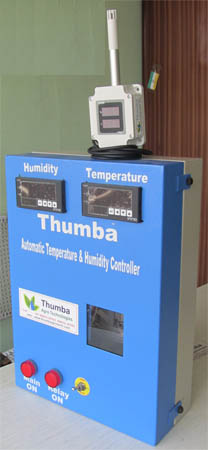
Mushroom shed climate control needs complete 24/7 automation. We offer different types of controllers to suit each customer's demand and budget.
A simple timer with real-time or cyclic ON and OFF control, and no sensors. The E-Cooler or mister is switched on and off by time. A very economic system for small mushroom farms, up to a 60 ft × 20 ft single shed.
Shutting the system off completely is done manually, according to the climate outside the shed. For small growers we arrange digital timers with suitable load relays within a budget of ₹10,000 including the starter.
The next level: fully automatic temperature and humidity controllers. The unit has proper sensors, analysers, relays or contactors sized to the motor power, and suitable wiring systems.
No doubt it is a very good system for controlling the shed's inner climate. But good quality sensors are very costly, and the system needs RO water to run.
Removing CO₂ and SO₂ gases from inside the shed is a very important matter. They are produced during the mushroom growing stage and, being the heaviest gases in the air, settle at the bottom near the floor. They must be removed periodically by forced air circulation through small SS insulated vents at the bottom of the shed. Otherwise they take up the oxygen space inside the shed and reduce mushroom yields.
This is easily done with our shed design and the E-Coolers' forced circulation. It is not possible with air conditioners, which recirculate the same inside air again and again. With an AC you must provide extra fans at the bottom, and insect problems come with that arrangement, adding maintenance and servicing. There is no such complication in our E-Cooler concept.
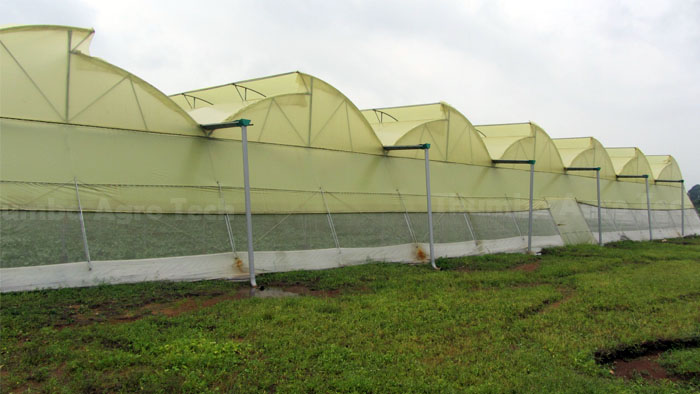
A proper shed design is very important to be compatible with our cooling system. The top must be properly insulated with aluminium foil or aluminium gypsum tiles to block UV rays. Otherwise the loss of temperature and humidity runs the cooling system unnecessarily, which reduces the system's performance and life and increases the power cost.
Many factors must be considered before shed construction:
Every shed needs its own individual cooling system with CO₂ removal facilities.
This is another of our advanced services, for mushroom growers where grid power is not available or where grid power costs are high. Based on my knowledge: if possible, take grid power to the shed, but use as little of it as you can. Use solar power wherever possible for the coolers, the pumps and the lighting.
In 2026 we have introduced many advanced solar systems ourselves, with models from 1 kW to 20 kW and advanced Lithium Iron Phosphate battery backups for 100% solar use. We can design this together with the initial shed construction investment. It is better to design with a solar option for future power needs, to avoid unwanted power expenses. See also our solar agriculture pumpsets.
Oyster and Milky mushrooms grow best between 24°C and 28°C. Button mushrooms need a cooler 20°C. In plain areas where room temperature can swing from 22°C to 28°C across seasons, that range is generally suitable for good growth and yield for most varieties.
Mushroom farming is very popular but delicate — El Niño and other climate shifts, particularly rising temperatures, affect production seasonally. In hill stations and tropical rain forest areas, temperature stays low (0°C to 24°C max), which suits button mushrooms naturally. But in plain areas temperature can reach 20°C to 42°C across seasons, well outside the ideal range without active climate control.
It uses only water. When water evaporates at a low temperature it absorbs heat from the atmosphere, which cools the shed and raises the humidity at the same time. That is entirely different from a high-power air conditioner, and it is why the running cost is so low.
E-Coolers suit tropical areas where summers reach 28°C to 41°C; they control 26°C to 30°C and 65% to 95% RH on single phase power and can use any farm water below 1,000 TDS. Fine misting is for hotter areas of 37°C to 47°C: high pressure nozzles make a 10 micron mist that raises humidity from 20% to 95% within 5 minutes, running only 2 minutes in every 15 to 30. 5 HP covers a 12,500 sq. ft shed, systems go up to 1 lakh sq. ft, run at 35 to 75 bar on complete SS 202 pipe lines, and need RO water below 100 TDS.
An AC can cool a shed, but it absorbs the humidity inside, down to around 30% RH, while mushrooms need 80%+. A 1,000 sq. ft shed needs at least a 4 ton AC using about 6,000 W on three phase power, against about 400 W of E-Coolers on single phase. An AC also recirculates the same air, so CO₂ is not removed, and it needs costly six-monthly servicing by a qualified technician.
No. E-Coolers are 100% successful for Oyster and Milky mushrooms, but Button mushrooms need 20°C, which evaporative cooling cannot reach in tropical areas on hot summer days. An air conditioner can reach 16°C and is better suited to Button mushrooms, though it dries the air.
Yes. A time-based controller uses a simple real-time or cyclic timer with no sensors. It gives more than 85% successful control for small farms up to a 60 ft × 20 ft single shed, at a budget of about ₹10,000 including the starter. Fully automatic temperature and humidity controllers use sensors, analysers and contactors; they control the climate very well, but good sensors are costly, need RO water, and must be cleaned regularly, because water above 60 TDS leaves salt deposits on them.
E-Coolers run on standard single-phase 220V electricity. The high-pressure fine misting system requires a 2 to 5 HP three-phase (3φ) power supply to drive the misting pump.
Yes. For a small shed it is well worth using 100% solar for the coolers, pumps and lighting. For medium and large projects, solar is best used to cut power costs alongside grid power. We supply solar systems from 1 kW to 20 kW with Lithium Iron Phosphate battery backup, and it is best designed in at the shed construction stage.
Yes. Share your shed size, location and target mushroom variety with us. We will recommend the right combination of E-Coolers and/or high-pressure fine misting and provide a quotation. Call or WhatsApp +91 98433 35703.
Tell us your shed size, location and mushroom variety — we'll recommend the right E-Cooler or fine misting setup and give you a quote.
Get a Free Quote WhatsApp Us +91 98433 35703More temperature control solutions for farms, sheds, and protected cultivation.