"First of all, I am very proud to be a farmer."
3.5 acres in a deep-dry region. No grid power. No chemical fertilizer. No pesticide. 95% natural farming, 5% organic — and real numbers to show for it.

I come from a farming community going back several decades. Only after that did I become an agriculture machine designer and manufacturer, an engineering consultant, and the CEO of this company — farmer first.
My father started teaching me basic agricultural practice in 1979, when I was five. We cultivated our own 30 acres of dry land — groundnut, cotton, millets, pulses and mulberry as the commercial crop — along with 3 acres of wet land growing paddy, sugarcane and betel leaf.
Those 45 years of practical knowledge are exactly what pushed me to design agriculture machines and modern farming practices that work without unwanted expenses. Everything on this page is what we do on our own land — not theory.
Our farm sits in a dry — really a deep-dry — region. The ground water level here has already dropped past 1,000 feet. That did not happen by accident. Five things caused it, and four of them are things farmers can still change.
Very little rain, and less of it every year.
The latest deep-well (tube well) pumpsets simply chase the water down further each year.
Free electricity is given to farmers, so very low-performance pumpsets stay in use — nobody counts the units.
No awareness in crop selection — coconut, banana and sugarcane being grown in dry places that cannot support them. This is the one nobody wants to hear, and it is the most expensive mistake of the five.
Our land is in an extremely dry area and depends on rainfall alone — for irrigation and for household water. So we dug one open well at 60 feet and two bore wells at 600 and 900 feet across 3.5 acres of dry land.
Even then the yield is minimal: about 30,000 litres per day, and in summer only 15,000 litres per day. Every cultivation decision has to be planned inside that limit. Water availability is not one factor among many — it is the factor.
"Necessity is the mother of invention."
Before a single sapling went in, we worked through seven factors. Most crop failures in dry regions are decided at this stage, long before anything is planted.
Those seven answers pointed to commercial horticulture tree crops. We planted Noni and Soursop at 15-foot intervals, with papaya as an intercrop on 7.5-foot lines — all irrigated by drip.
Selecting the irrigation system is the most important decision on a farm, and it depends on water availability, the crop, the local climate, cost and maintenance. Most people have very little knowledge here — and it is the choice that determines every year that follows. Three systems are used in agriculture worldwide.
| System | Powered By | Mainly For | Key Characteristics |
|---|---|---|---|
| Flood Irrigation | River, canal, ponds | Paddy, sugarcane, banana | Primitive method. Labour oriented, very high water consumption, and less yield than the advanced systems. |
| Drip Irrigation | Electric, solar, diesel — rarely gravity in hills | Tree crops, vegetables, mulberry | Advanced system. 60% water saving over flood irrigation, less labour, high yields. Auto fertigation raises yield further. |
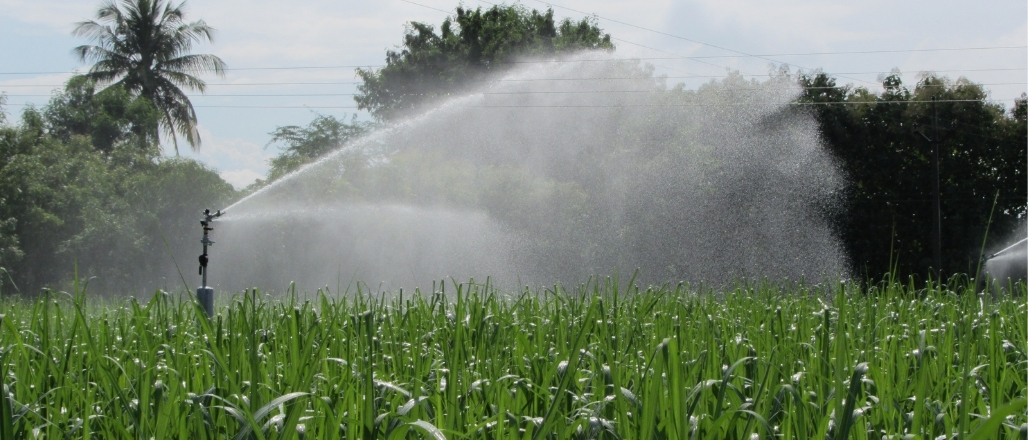
| RainGun & Sprinkler | High-pressure pumpsets on electric, solar or diesel | Field crops, fodder, estates, grounds | Advanced technology. Controls climate, temperature and humidity; increases natural bio-organism growth for soil health. Maximum yield with minimum inputs. 3× water saving. Costly, but lasts up to 50 years. |
We are a leading RainGun system installer in India and on international projects. I have 23 years of RainGun design experience and 350+ completed projects. There is no doubt that RainGun is one of the highest-performing models in farming — best in water savings, climate control, disease control, and a system life beyond 50 years.
And I still did not choose it for my own farm.
The reason is honest and simple: too little water, a dry area, and extremely hot summers. RainGun needs water to work with. We do not have it here. The right system is the one that fits your conditions — not the one the installer sells.
So we selected drip irrigation for the full 3.5 acres. If your conditions are suited to RainGun, see our RainGun & Sprinkler systems — and if they are not, we will tell you so.
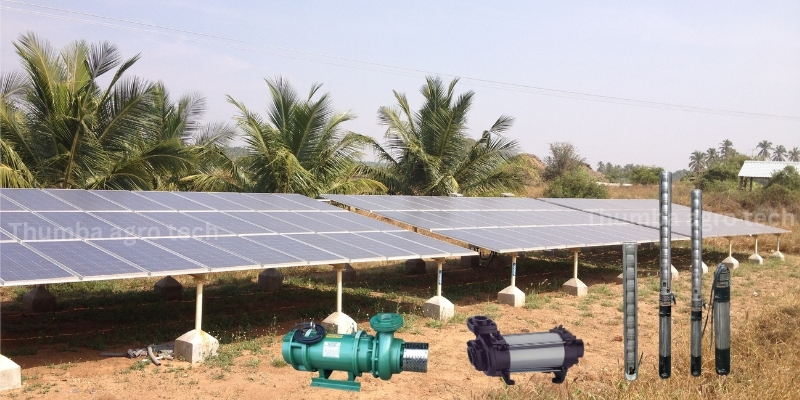
There is no grid power connected to our farm at all. It was designed from the start as a completely sustainable one, running on solar power for every farm need.
Runs every open well and bore well motor on the farm. See our solar agriculture pumpsets.
The whole area is controlled by just three valves — simple enough for one person to operate.
Enough to irrigate one acre of tree crops, and only on alternate days.
Individual water quantity per plant. We run the drip manually, judging by climate, crop status, rainfall and harvesting stage.
First you must know the difference between the two.
Natural farming means no inputs are given to the crop — no chemical fertilizer, no organic fertilizer, no pesticide. Just like a forest, the trees and crops grow on their own and give better yields. In a natural forest, yield does not matter. In agriculture it does. So we adopt a few natural practices — soil preparation, planting method, weed control, and some special care for disease control — and nothing else.
Farmers normally plough with a tractor or animal-drawn plough at least three times a year, down to nine inches. Repeated every crop cycle, this reduces soil health year after year.
Healthy topsoil needs 1.75% to 3% total carbon content. In practice it has fallen dangerously to around 0.5% — and our farm had the same problem.
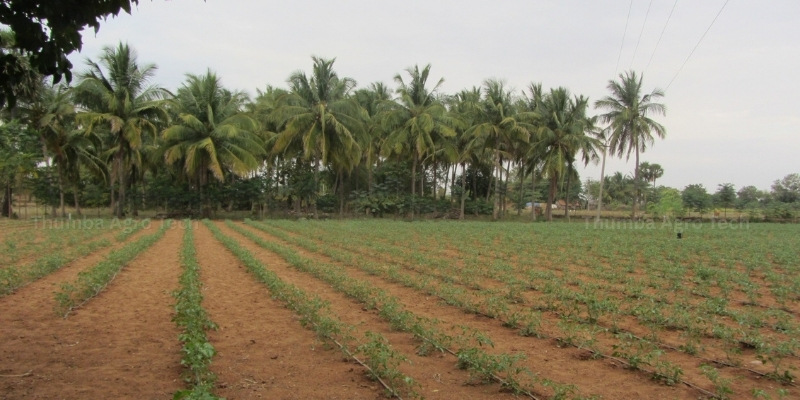
Fortunately we chose tree crops, whose roots reach three feet down. So we stopped ploughing six years ago. The only soil we turn is at three feet depth, with an excavator, and only for the tree planting pits.
After loosening that soil we add whatever agri waste we have and leave it for 20 days. Only then do the saplings go in. From there, each tree gets as little as 3 litres of water a day through adjustable drippers.
This is the part most farmers find hardest to accept. One manual weeding at the start is a must. After that we never remove weeds again — we simply trim them above 2 inches.
Once trimmed, our crop dominates them and grows fast. The weeds then do three jobs for us:
In practice: never pull weeds out with the roots. Trim them at a set height with a brush cutter, working around the drip lateral hoses without removing them. One machine and one person can trim an acre a day. We never use weedicides or power weeders.
We never give any direct organic fertilizer to our crops either. But sometimes we want to build up the population of fertilizer-producing bacteria that maintain soil nitrogen, phosphorus and carbon. That is not a big job.
We inject liquid seaweed extract and natural cow dung fertication liquid, carrying micro-organisms that support the soil, straight into the drip irrigation system using a battery sprayer. The whole operation takes 15 minutes and needs no labour at all.
Note the distinction: this feeds the soil biology, not the plant. That is what keeps it inside natural farming rather than turning it into input-based organic farming.
The main difficulties in natural or organic farming are disease control and the fact that extreme yields are not easy to reach. We have managed the diseases successfully in papaya, Noni and Soursop — but not all of them, and we will not pretend otherwise.
We grow the Taiwan variety "Red Lady". In our experience, because no chemical fertilizer has ever been used on this farm, the trees naturally withstand virus pressure — no special pesticide is needed. If virus effect appears on a leaf, we immediately inject seaweed extract to strengthen the plant.
White fly also attacks the trees, and must be controlled at the initial stage — immediate action is essential. No chemical spray is needed: pressurised clean water alone is enough. Handled early, it never affects the yield.
We have not found a successful control concept for these. Up to 10% crop damage does not affect our overall yield, and we accept it — we lost 100 papaya trees out of a 1,000-tree plantation. We still refuse to use chemical or organic control inputs for it. Sufficient irrigation on alternate days, with no water stress, helps plants resist nematodes. Stem borer, though, damages healthy fruiting papaya easily.
These are our actual figures, not projections.
| Papaya saplings planted | 1,000 |
| Plants survived | 850 |
| Trees giving good yield | 700 |
| Trees giving 50% yield | 150 |
| Total harvested (20 months from planting) | 45,000 kg |
| Average realised price | INR 25 / kg |
| Total revenue | INR 11,25,000 |
| Total expenses | around INR 1,00,000 |
Expenses are that low because of natural farming — there are almost no inputs to buy.
Because of natural farming the taste and fruit quality are better than the inorganically grown papaya in the market. We sell directly to nature lovers and to hygiene markets at INR 40/kg — but only 25% of the fruit can be placed in that channel. The other 75% goes to direct merchants at INR 20/kg, and they bring their own harvesting and loading labour to the field, so harvesting costs us no work at all.
"Based on my experience, only 1 acre of papaya cultivation is enough for good family maintenance."
Planted for fruit juice processing. Comes to yield after 2 years. In 2026 it gives 900 to 1,500 kg every 45 days, right through the year.
We process the fruit for 6 months to 1 year to make good-quality noni juice. It is valued for its antioxidant content, and it is an excellent crop for South Asian terrain — very little water is enough.
Grown for both fruit and leaves. Yield comes only after 3 years. The fruit and leaves contain natural compounds known as acetogenins, which is why soursop is long valued in traditional herbal practice.
2026 was our first harvest — 250 kg between January and March, sold to the local market at INR 200 to 400 per kg.
We grow and process Noni and Soursop as food and herbal-infusion crops. We make no medical claims for them, and nothing here is intended as health advice — please consult a qualified doctor about any health condition.
We are planning further value-added products. The first is already selling: using soursop leaves we make a powder for soursop infusion tea, marketed in a glass bottle under our own brand name Thumba Herbz at INR 400 per 40 grams.
We put our whole experience of natural and organic farming into this farm. Many people have already visited to see the farming practices, the irrigation technology, the solar setup, the drip injection system and the yields for themselves.
This is the right time to change our agriculture practices and make farming a profitable business. We have many large-scale natural and organic farming technologies available. Call us for the details.
Thanks to all.
— Nallamuthu
CEO, Thumba Agro Technologies
In natural farming no inputs at all are given to the crop — no chemical fertilizer, no organic fertilizer, no pesticide. Trees and crops grow the way they do in a forest. Organic farming still applies inputs, but organic ones rather than chemical. On our own farm the method is roughly 95% natural and 5% organic — the 5% is occasional seaweed extract and cow dung fertication liquid injected through the drip line to build up soil bacteria, not to feed the plant directly.
Yes. We grow the Taiwan Red Lady variety with no chemical fertilizer and no chemical pesticide. In our experience a papaya tree that has never been fed chemical fertilizer naturally withstands virus pressure far better. White fly is controlled with pressurised clean water alone if you act at the first sign. Nematodes and stem borer remain unsolved as of 2026 — we accept up to 10% crop loss rather than spray.
Our farm runs on 15,000 litres a day in summer and about 30,000 litres a day the rest of the year, from one 60 ft open well and two bore wells at 600 and 900 feet. With adjustable drippers a young tree gets as little as 3 litres a day. Irrigation runs on alternate days, and 15 to 30 minutes is enough to cover one acre of tree crops.
It depends on water availability, crop, local climate, cost and maintenance. Flood irrigation is primitive, labour heavy and wastes water. Drip saves about 60% of the water flood irrigation uses and suits tree crops and vegetables. RainGun and sprinkler give maximum yield with minimum inputs, control temperature and humidity, and last 50 years plus — but need more water and a high-pressure pumpset. We install RainGun systems for a living, yet chose drip for our own farm because we simply do not have the water for RainGun in a deep-dry area.
Ours does. There is no grid power connected to our farm at all. A 6.8 kW solar system runs every open well and bore well motor across all 3.5 acres, and the whole farm was designed as a completely sustainable one from the start.
From 1,000 papaya saplings we harvested 45,000 kg over 20 months at an average realised price of INR 25 per kg — about INR 11,25,000 in total, against roughly INR 1,00,000 of expenses, because natural farming removes almost all input cost. In our experience one acre of papaya, well grown, is enough to maintain a family comfortably.
Tell us your land size, water availability and power situation. We will tell you honestly what will work — including when the answer is not the system we sell.
Talk to Us WhatsApp Us +91 98433 35703