Groundwater, drilling depth, the three pump types, correct sizing, installation and the risks of going very deep — written from 23 years of designing submersible motors and pumps.
By Nallamuthu, mechanical engineer and founder, Thumba Agro Technologies, Palani
"Water is indispensable to the world."
— Thiruvalluvar
Realizing the truth behind Thiruvalluvar's timeless words, the first thing almost everyone does when starting agricultural activities or constructing a new house is to drill a borewell. Without water, no work can proceed.
At the same time, the required quantity of water is not available everywhere. In some places, even after drilling a borewell to depths of 1,000 feet, there may not be enough water even for drinking. This is one of the challenges posed by nature.
However, with careful planning and a proper understanding of groundwater and pumping technology, unnecessary financial losses can be avoided and the required quantity of water can be extracted and utilized efficiently. With this objective, I would like to explain some basic technical aspects that can help you make informed decisions.
I would like to share the experience I gained over the past 23 years, up to 2026, in the design of submersible motors and pumps.
As a mechanical engineer, I have designed and manufactured motors ranging from 0.5 HP to 100 HP for residential, agricultural and solar-powered applications, and installed them in various locations across India.
Each of these motors was individually designed based on the required water discharge, pressure, head, electrical power availability and application requirements.
When rain falls, some of the water enters the spaces and fractures beneath the ground and is stored between layers of rock due to gravity. This stored water is known as groundwater.
Depending on the type of rock and geological formation in a particular location, minerals such as sodium, calcium and magnesium can dissolve into the groundwater, increasing its salinity.
| Dissolved Salts | What It Generally Means |
|---|---|
| 300–600 PPM Parts Per Million |
May generally be suitable for drinking, depending on the overall water-quality parameters. |
| 1,500–4,000 PPM | Dissolved salts and other contaminants. Should not be assumed suitable for drinking without proper laboratory testing. |
Where groundwater has high total dissolved solids (TDS), an appropriate Reverse Osmosis (RO) purification system may be used to make the water suitable for drinking, provided the system is properly designed and maintained.
People living near large industries that discharge chemical wastewater should be particularly careful about groundwater quality. Groundwater in such areas should be tested for possible chemical contamination before being used for drinking.
It is sometimes observed that water obtained from relatively shallow depths has lower salinity, while deeper groundwater may have higher mineral content. However, this is not a universal rule. Groundwater quality depends largely on the local geology and aquifer characteristics.
Therefore, proper water-quality testing is essential before using borewell water for drinking.
One of the biggest concerns people have is:
"What happens if the water in a relatively shallow borewell dries up after a few years?"
First, it is important to understand the groundwater conditions of your locality. Knowing the local groundwater level and geological conditions can help determine an appropriate borewell depth.
However, simply drilling a borewell an additional 200 feet below the groundwater level does not automatically guarantee water availability for 20 years. Groundwater availability depends on rainfall, aquifer recharge, geological formations and the rate at which groundwater is extracted.
There can also be competition between neighbouring borewells.
Suppose a borewell on one property is 300 feet deep, while a neighbouring property drills to 800 feet and installs a pump at 600 feet. If the neighbouring borewell extracts a very large quantity of water continuously, it may affect groundwater levels in the surrounding area.
On the other hand, if groundwater extraction is limited to a sustainable quantity, the impact on neighbouring wells may be considerably lower.
Therefore, borewell depth should be determined based on local geological surveys, groundwater conditions, existing borewell data and the required water quantity, rather than simply choosing a greater depth.
In areas with poor groundwater availability, deeper drilling may sometimes be necessary. In areas with good groundwater potential, a shallower borewell may be sufficient.
Since drilling a borewell again is expensive and difficult, proper assessment before drilling is extremely important.
For residential applications, daily water requirements are generally in the range of approximately 2,000–5,000 litres, although actual requirements vary depending on the number of occupants and usage.
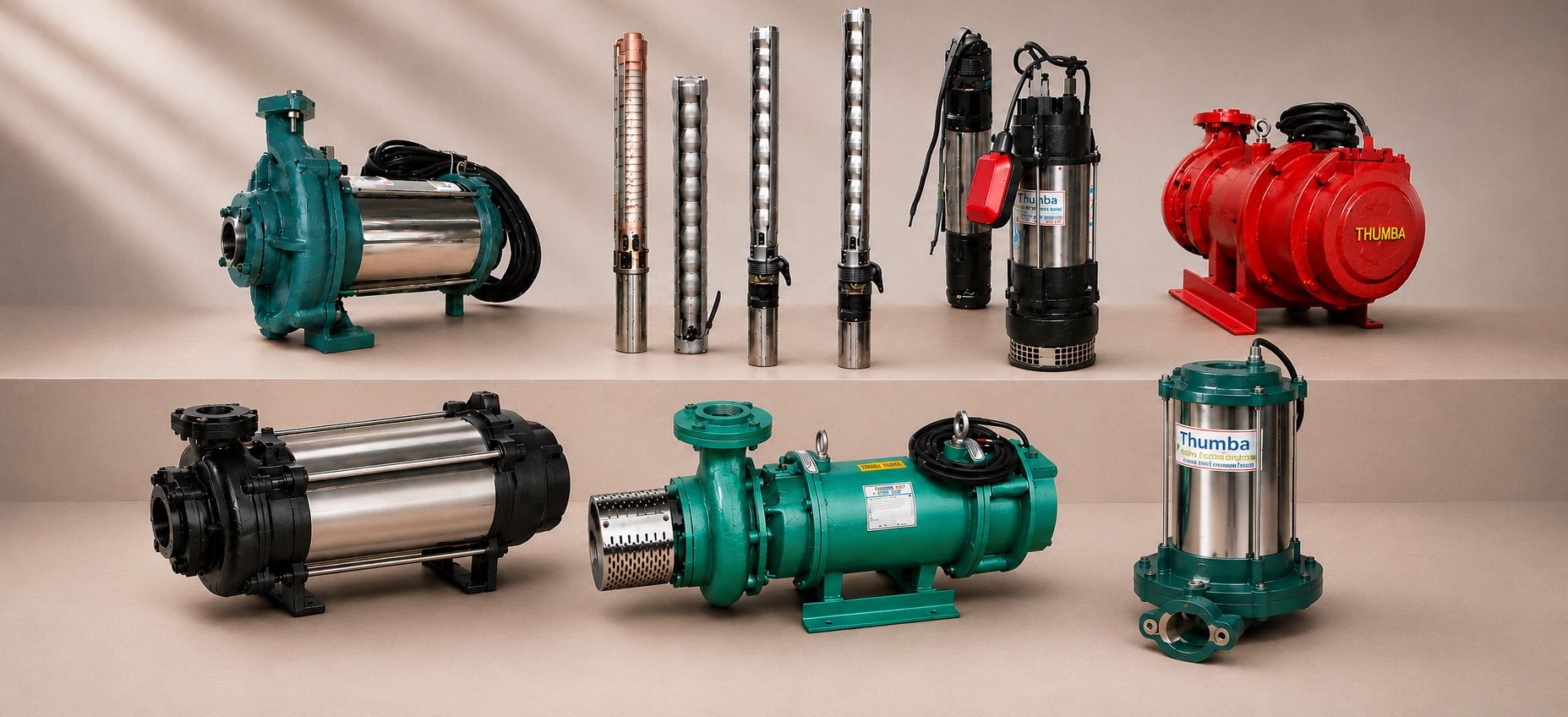
Three common types of systems have traditionally been used for borewell applications:
1970–1985 era
Second generation
Modern standard
From approximately 1970 to 1985, jet pumps were widely used for extracting water from borewells.
A jet pump works by forcing water through a specially designed jet. The resulting pressure difference creates a vacuum effect that helps lift water upward.
However, jet pumps have several limitations. They are generally effective only at relatively shallow depths and their performance decreases significantly as the lifting depth increases. They also tend to deliver comparatively low quantities of water while consuming more electricity for the amount of water delivered.
Maintenance issues may include problems with the foot valve, nozzle and NRV (Non-Return Valve). Because of these limitations, many users gradually moved toward compressor systems and later to submersible pumps.
Jet pumps are still used in some locations, particularly where the borewell is relatively shallow. However, they may not be the most energy-efficient solution for many modern applications. Another disadvantage is their relatively high operating noise.
Compressor pumps can be considered a second-generation borewell pumping system.
In this system, compressed air is supplied through a pipe to the lower portion of the borewell. When the compressed air is released, it forms air bubbles and reduces the effective density of the water-air mixture. This helps lift the mixture upward through the delivery pipe.
This system is an improvement over conventional jet pumps in certain applications. However, compressor systems also have practical limitations.
For example, a 2 HP compressor may be capable of lifting water from certain depths, depending on the system design and geological conditions. Claims that a conventional compressor can efficiently pump water from extremely deep levels should be carefully evaluated.
Similarly, installing a very long air pipe does not necessarily mean that the compressor can effectively lift water from the full depth of the borewell. Excessive pipe length can increase friction losses and reduce system efficiency. The actual operating depth should therefore be determined according to the compressor capacity, borewell construction, water level and required discharge.
The compressor also produces considerable noise, which can be inconvenient for nearby residents.
Another concern is maintenance. As the compressor piston and associated components wear, proper servicing becomes important. In oil-lubricated compressors, poor maintenance may create a risk of oil contamination, so the system should be maintained carefully. Compressor systems may also consume more electricity than a properly selected submersible pump for comparable applications.
Where several low-yield borewells must be worked from a single compressor, a sequential compressor timer can run up to 16 wells in turn from one unit.
Submersible pumps are modern electro-mechanical pumping systems designed to operate underwater inside the borewell. Their major advantages include:
Submersible pumps have become increasingly popular since the 1990s and are now widely used for borewell applications.
This is where many people make mistakes.
For example, a borewell may have water available at around 250 feet, but a pump designed for a much greater head, such as 500 feet, may be installed unnecessarily.
A pump should not be selected simply based on its HP rating or maximum pumping depth. The correct pump should be selected based on the required discharge, total dynamic head, static water level, pumping water level, borewell depth, pipe diameter, pipeline length, friction losses and available electrical supply.
A correctly selected pump can provide the required quantity of water while reducing energy consumption and operating costs.
With these details, the appropriate pump model and specifications can be selected more accurately.
Using modern pump technology, it is possible to design a 1 HP pump for a specific application that can operate at a head of approximately 200 feet while delivering around 100 litres per minute, depending on the actual system conditions.
If the same borewell is instead fitted with a 1.5 HP pump designed for a much higher head, such as 500 feet, the pump may deliver substantially less water if the actual system conditions do not match its design operating point. The larger pump may also cost considerably more.
Therefore, simply purchasing a higher-HP pump does not necessarily mean that you will get more water.
Borewell pump manufacturers offer numerous models at every HP rating, each with different head-discharge characteristics. Proper technical selection is therefore extremely important.
After selecting a pump suitable for the actual operating conditions, it should be installed using a properly rated uPVC column pipe or another suitable pipe system. The pipe grade and pressure rating should be selected according to the installation depth and operating pressure.
Installation should be carried out by qualified personnel. Special attention should be given to:
A properly installed NRV helps prevent water from flowing back through the pump when the motor stops. Uncontrolled reverse flow can cause the pump assembly to rotate in the reverse direction and may contribute to mechanical damage, including thrust-bearing problems.
Proper installation is therefore essential for achieving a long operating life.
In locations where groundwater levels have fallen considerably, there may be situations where a pump has to be installed at depths approaching or exceeding 1,000 feet.
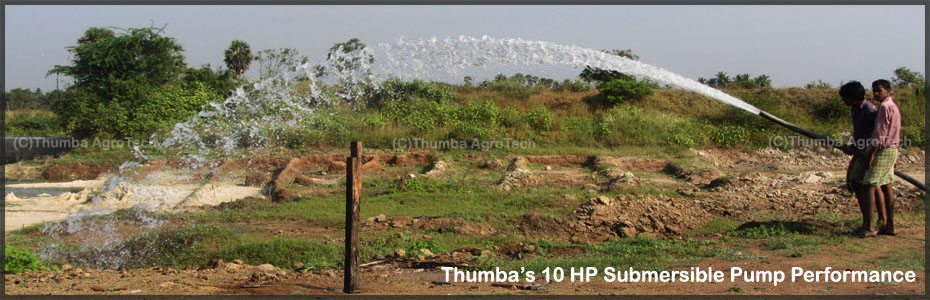
From a pump-design perspective, it is technically possible to manufacture high-head pumps capable of lifting water from such depths, and up to 2,000 feet. In 2026 we designed a 4 HP advanced stainless steel fabricated pumpset with a pumping capacity of 1,180 feet. There is no doubt that a suitably designed multi-stage pump can be engineered for very high heads.
However, the challenge is not simply whether the pump can generate the required pressure. There are several other factors that must be considered.
Imagine a vertical column of water approximately 1,000 feet high. When the pump is suddenly stopped, the moving water column can generate a hydraulic pressure surge known as water hammer.
This sudden pressure can place significant stress on the impellers, pump casing, shaft, couplings, pipes, valves and NRVs.
If the system is not properly designed to control these pressure surges, repeated damage may occur — and many owners never find out why their pumpset keeps failing after only a short time.
Deep installations also present significant maintenance challenges, because removing and reinstalling a pump at such depths is difficult and expensive.
Another important consideration is the electrical cable. When a submersible pump is installed at a very great depth, the cable length becomes substantial. If the cable cross-section is not properly selected, voltage drop can become excessive.
Excessive voltage drop can cause:
Therefore, cable size must be calculated based on motor power, operating current, cable length, voltage, installation conditions and permissible voltage drop.
In my view, except where deep pumping is genuinely necessary for essential drinking-water requirements, installing pumps at extremely great depths should be approached with caution.
The issue is not merely the cost of the motor or maintenance. Excessive groundwater extraction can contribute to declining groundwater levels and may affect the long-term sustainability of the aquifer.
Groundwater is a shared natural resource. Therefore, before drilling deeper or installing a higher-capacity pump, it is important to consider:
Protecting groundwater today means preserving a valuable resource for future generations.
Rather than extracting as much water as technically possible, we should aim to extract only what is necessary and sustainable.
If you are planning a new borewell or replacing an existing borewell pump, the following information will help determine the appropriate pump:
Providing these details allows the pump to be selected based on actual engineering requirements rather than simply choosing a higher HP motor.
For technical clarification regarding borewell pumps, submersible motors and pump selection, you may contact:
Borewell depth, water quality and pump selection.
A pump should not be selected on HP rating or maximum pumping depth alone. It should be selected from the required discharge, total dynamic head, static water level, pumping water level, borewell depth, pipe diameter, pipeline length, friction losses and the available electrical supply. To size a pump accurately we need the total depth of the borewell, the depth at which good water was encountered, the static water level, the daily water requirement, the required flow rate, the number of floors if it is an apartment, whether the supply is single phase or three phase, the required delivery pressure, and the pipe size and pipeline length.
No. Manufacturers offer many models at every HP rating, each with different head-discharge characteristics. A 1 HP pump designed for the actual conditions may deliver around 100 litres per minute at about 200 feet of head, while a 1.5 HP pump designed for a 500 foot head may deliver substantially less water in that same borewell, and cost considerably more. An oversized pump raises purchase cost and electricity consumption, runs inefficiently and places unnecessary mechanical stress on the system.
Depth should be decided from local geological surveys, groundwater conditions, existing borewell data and the required water quantity — not simply by drilling deeper. Drilling an additional 200 feet below the groundwater level does not automatically guarantee water for 20 years, because availability depends on rainfall, aquifer recharge, geological formations and the rate at which groundwater is extracted. Since redrilling is expensive and difficult, proper assessment before drilling is extremely important.
It must be tested before being used for drinking. Water containing roughly 300 to 600 PPM of dissolved salts may generally be suitable depending on the overall water-quality parameters, while water at 1,500 to 4,000 PPM should not be assumed suitable without proper laboratory testing. Where total dissolved solids are high, a properly designed and maintained Reverse Osmosis system may be used. Anyone living near industries that discharge chemical wastewater should have the water tested for chemical contamination.
From a pump-design perspective it is technically possible — a suitably designed multi-stage pump can be engineered for very high heads, and in 2026 we designed a 4 HP advanced stainless steel fabricated pumpset with a pumping capacity of 1,180 feet. The real challenge is not whether the pump can generate the pressure, but water hammer, electrical voltage drop over a very long cable, and the difficulty and cost of removing and reinstalling a pump at that depth.
A vertical column of water roughly 1,000 feet high carries considerable momentum. When the pump stops suddenly, that moving column generates a hydraulic pressure surge known as water hammer, which stresses the impellers, pump casing, shaft, couplings, pipes, valves and non-return valve. If the system is not designed to control these surges, damage repeats — and many owners never find out why their pumpset keeps failing after only a short time.
Pump sets designed against the requirement, not picked off a shelf.
Send us the depth, water level and your daily requirement — we'll size the pump against your actual conditions, not a catalogue.
Get a Free Quote WhatsApp Us +91 98433 35703