Advanced Solar Pumpsets · Agriculture, Residential & Industrial · 1HP to 100HP · 30 to 1600 Feet Depth
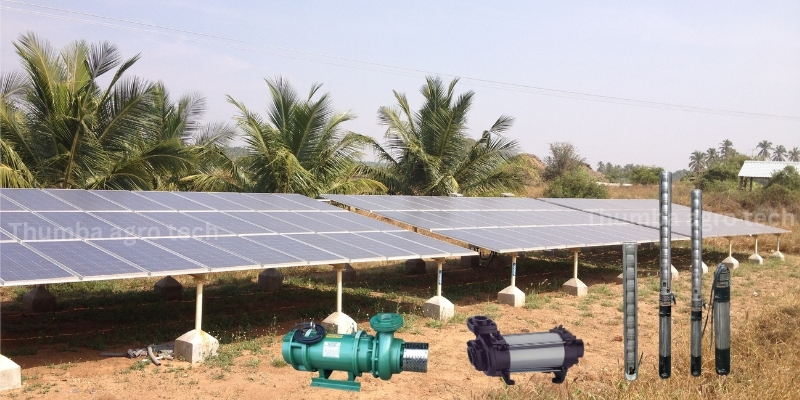
Based on our vast experience in submersible motor designing, combined with deep Solar power system knowledge, we introduced a completely new range of advanced Solar Pumpsets for Agriculture farming. These pumpsets deliver more than 25% Solar panel efficiency and 55% pumping efficiency in motors and pumps — a result of designing both the solar system and the submersible pumpset in-house, so both components are optimised together from the ground up.
Why CIGS panels outlast all others
CIGS (Copper Indium Gallium Selenide) panels are manufactured using rare-metal semiconductor materials that give far greater longevity than standard crystalline panels. The CIGS systems we installed back in 2014 are still in running condition today — 13 years later. If you want a solar irrigation system designed to last a generation, CIGS is the proven choice. Ask our team for availability.
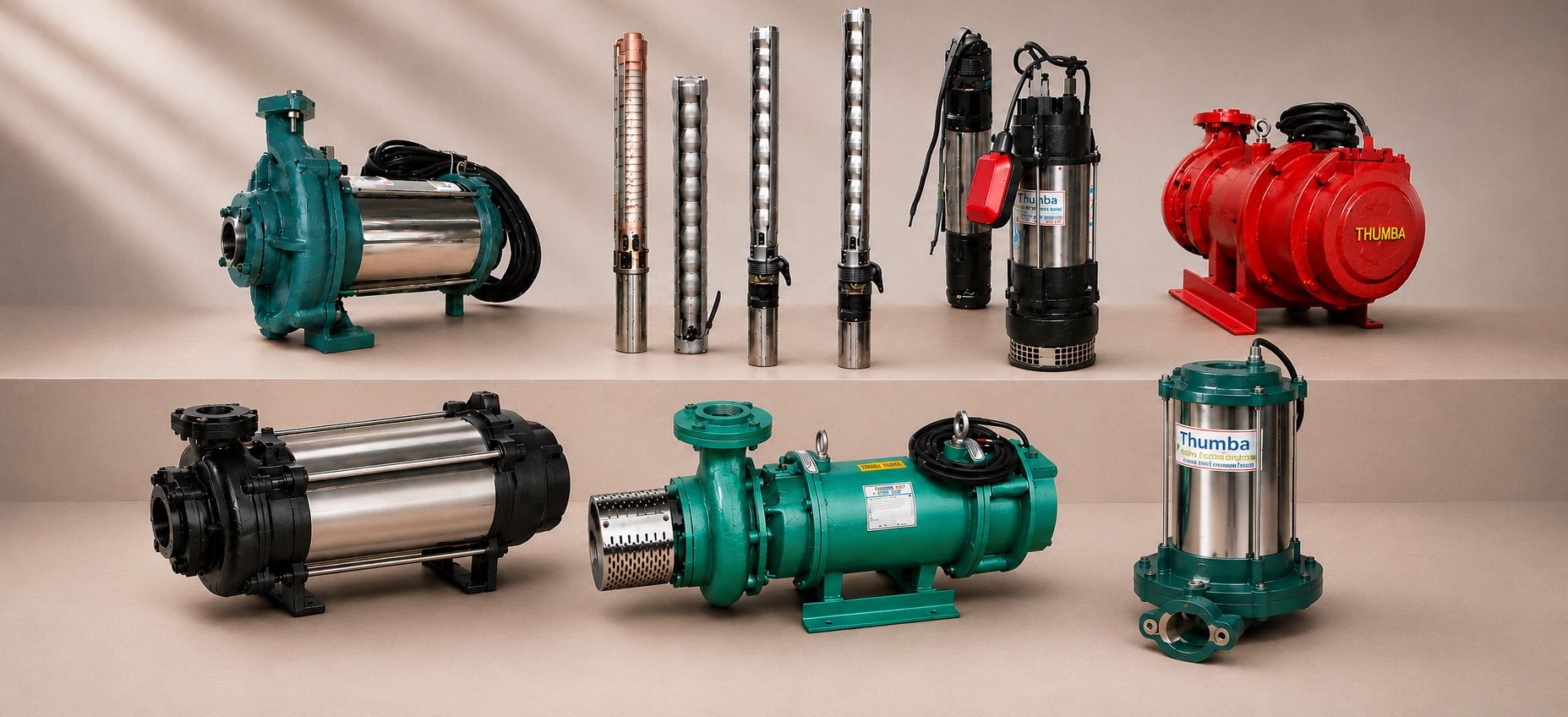
We supply Residential, Agriculture and Industrial Solar Pumpsets from 1HP to 100HP, handling depths from 30 feet to 1600 feet — using our own Stainless Steel fabricated submersible pumpsets. Every system is sized after an assessment of your water source, depth, required discharge, and available solar irradiance at your location.
| Power Range | 1HP to 100HP |
| Depth Range | 30 feet to 1600 feet |
| Applications | Agriculture, Residential, Industrial |
| Solar Panel Efficiency | More than 25% (Bifacial panels) |
| Pumping Efficiency | 55% in motor and pump |
| Panel Options | Bifacial (25%+), CIGS (19%), Mono / Polycrystalline |
| Pumpset Material | Stainless Steel fabricated submersible |
| Water Sources | Borewell, Open Well, Pond, Stream |
| In Production Since | 2013 (13+ years) |
There are many different technologies being sold in solar pumping today, and the highest-efficiency motor on paper is very often the wrong machine for a farm. Before you select a system, you must consider your application, the service ability in your local area, and the cost of the system. In our field experience these four factors decide whether a solar pumpset is still working ten years later.
If grid power is already available at your pump and solar is an addition rather than a replacement, an AC pumpset is the better choice — and that describes almost 75% of areas. With an AC system you can run the same motor on solar during the day and on grid power at night, which matters wherever more than 10 hours of running per day is essential.
Your local electrician's support is essential. Whenever the controller or the motor needs attention, local assistance is a must — which means the technology itself has to be something local technicians can handle. This is again where AC pumpsets and standard inverters (VFDs) rule the sector: every service town has someone who can work on them.
Spares for the motor, the pump and the pump controller must be available in your local market. More than 90% of the pumps in the market are AC, so AC spares are easily available almost anywhere. A premium motor with a two-week wait for a replacement part is a stopped irrigation system.
The pumpset and controller must be affordable for a normal farmer. BLDC and PMSM motors cost considerably more than a standard AC pumpset. Their efficiency may be higher — but so is the price. In practice you can simply add 2 to 3 extra solar panels to an AC system and match that output at a lower total cost, with none of the service and spares problems.
Four motor technologies are used in solar pumping systems: AC, DC (brushed), BLDC and PMSM. They differ far more in service reality than in specification. Here is how they compare, followed by an honest note on each.
| Type | Efficiency | Controller | Suitable Depth / Head | Service & Spares |
|---|---|---|---|---|
| AC Pumpset Our recommendation |
55% | Standard VFD / inverter | 30 ft to 1600 ft — open well, borewell, deep borewell | Easy everywhere — 90%+ of pumps are AC |
| DC (Brushed) | Above 80% (theoretical) | Not needed — direct run | Max 40 ft head, 0.5–2 HP only | Brushes need periodic replacement; voltage loss in DC lines is a real issue |
| BLDC | 90%+ | Electronic driver — costlier than an AC VFD | Open well below 60 ft; borewell below 600 ft (300 ft is better) | Specialist service only; permanent magnet and commutator spares are expensive |
| PMSM | 95%+ — highest of all | Electronic controller | Premium installations where efficiency is the only priority | Needs qualified engineers for controller / circuit faults — not feasible in most markets |
More than 90% of the pumpsets used in solar pumping are AC pumpsets, for one simple reason: they run efficiently on grid power and solar power together. That single property removes the two biggest limitations of a solar irrigation system — cloudy days and night running.
| Open well water pumping | Solar + Grid power |
| Deep borewell pumping | Solar + Grid power |
| Long distance pipelines — up to 20 km | Solar + Grid or only solar power |
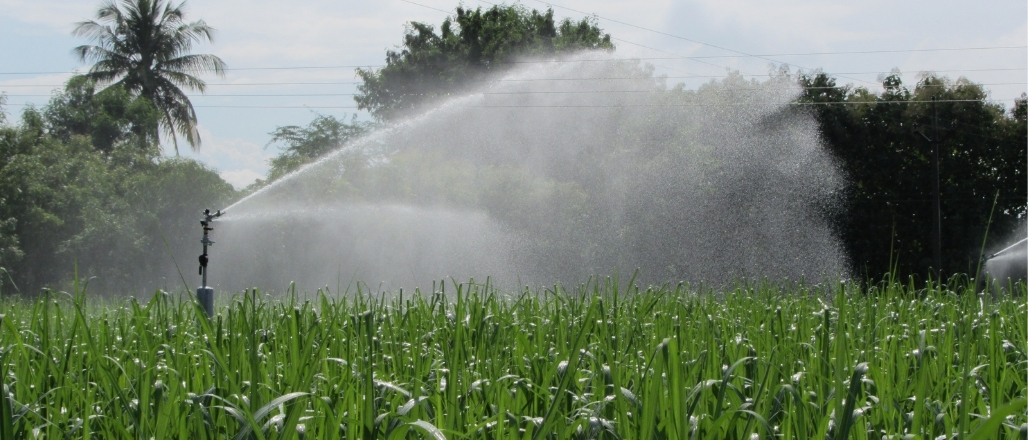
| RainGun & sprinkler system high pressure pumpsets | Solar + Grid or only solar power |
| Overhead tank filling — 600 ft to 1500 ft | Solar + Grid or only solar power |
Our verdict, based on field experience
Weighing all four factors together — cost, service, spares and grid suitability — AC pumps are the best choice. Its efficiency is the lowest of the four technologies (55% achieved now), but every other factor is strongly in its favour, and efficiency is the one shortfall you can close cheaply by adding two or three more panels.
This is an efficient technology in solar pumping, but it comes with a brush carrying the rotor current, and that brush means recurring maintenance. It is not feasible for deep borewells, so it is used mainly in open wells below 40 feet and in tank pumping applications — normally as an open well monoblock, where it gives more discharge. Because of the maintenance it has never become popular in the market, and voltage loss in DC current is a big issue over any distance.
| Used in | Open wells, tank filling |
| Max head | 40 ft |
| Power | 0.5 HP to 2 HP categories |
| Motor | Brush type DC motor |
| Efficiency | Above 80% (theoretical) |
| Controller | Not necessary — direct run on DC |
BLDC is a genuinely good technology in the solar pumpset sector. It is a DC motor with no brush, which eliminates the periodic service of changing brushes, and it is slowly becoming popular. Technically a BLDC belongs to the AC motor family — it simply runs on electronic commutation instead of electro-magnetic induction or synchronous operation.
That electronic driver is mandatory for BLDC control, and it is considerably costlier than an AC motor VFD. Efficiency is better than an AC motor — but service facilities cannot be provided in every area, and that is precisely where it fails. Spares are also expensive: permanent magnets, the electronic commutator, the motor body. It is not able to meet continuous operation, overloads and overheating in heavy duty applications such as 500 to 1500 feet borewells. For those, an AC motor is best.
Choose a BLDC pumpset for:
Avoid selecting BLDC for deep borewells. And however good the machine is, the service facility question decides it — if reliable service is available in your area, BLDC is a technology you can safely choose.
PMSM is a Permanent Magnet Synchronous Motor — almost the same premium technology concept as BLDC. Its efficiency is the maximum of any pumpset (95%+), but the cost is much higher than every other option. It also needs qualified engineers to rectify faults in the controller and electronic circuits, and that level of support is simply not feasible in most of the market.
Efficiency is only one number. The reason an AC solar setup wins on a working farm is the sheer range of things a single system will run:
Everything above is possible on an AC solar system. The efficiency may be lower than DC-based technologies — but the applications are unbeatable. That is the trade we recommend to almost every farmer who asks us.
Thumba solar pumpsets are built on two deep areas of expertise: submersible motor design (our core business since 2003) and solar power system engineering. Because we design both the motor and the solar system in-house, both are optimised together — delivering more than 25% solar panel efficiency and 55% pumping efficiency, significantly above standard off-the-shelf solar pumps. Our stainless steel fabricated pumpsets are also built for long-term agricultural field conditions, not just for spec-sheet performance.
It depends on your location's sunlight pattern and your priorities. Mono Crystalline panels work well in low-light or partially shaded areas. Polycrystalline panels suit areas with consistent strong sunlight. CIGS Thin panels offer exceptional lifespan — our 2014 installations are still running in 2026. Bifacial panels (2026 current standard) give 25%+ efficiency by generating from both front and back surfaces, and need 40% less space than older panel types. Our team will recommend the right option after assessing your site.
CIGS stands for Copper Indium Gallium Selenide — rare metals used as semiconductor materials in thin-film solar panels. This semiconductor composition gives CIGS panels exceptional longevity: the systems we installed in 2014 are still fully operational 13 years later. Their thin-film construction also makes them more resilient to microcracks caused by temperature cycling in outdoor agricultural environments.
We supply solar pumpsets from 1HP to 100HP, handling depths from 30 feet to 1600 feet — covering shallow open wells through to very deep borewells. All pumpsets use stainless steel fabricated submersibles. The right HP and stage configuration is determined by your well depth, required discharge volume, and the crop or use case. Our team does a free assessment before recommending.
Yes — that is one of the main advantages. A solar pumpset runs entirely on energy from the solar panels, with no grid electricity required. This makes it ideal for farms in remote locations, areas with unreliable grid supply, or farmers who want to eliminate recurring electricity costs for irrigation. For 24-hour water availability, a battery bank can be added to store surplus daytime solar energy for use at night.
On efficiency alone the order is PMSM (95%+), BLDC (90%+), DC (above 80% theoretical) and AC (55%). But on a working farm, efficiency is only one of four factors — the others are grid power availability, local service facility and spares availability, and cost. On those three, AC wins decisively: more than 90% of pumps in the market are AC, any local electrician can service an AC motor and a standard VFD, and spares are available in every town. Based on our field experience we recommend AC pumpsets for the great majority of installations. The efficiency gap is the one shortfall you can close cheaply — simply add 2 to 3 extra solar panels and you match BLDC or PMSM output for less total cost.
An AC pumpset. BLDC motors are normally recommended only for borewells below 600 feet (300 feet is better) and open well pumping up to 100 feet — they cannot reliably meet the continuous operation, overload and overheating demands of heavy duty deep-well applications from 500 to 1500 feet. Brushed DC pumps are not feasible for deep borewells at all; they are limited to about 40 feet of head. Our stainless steel fabricated AC submersible pumpsets handle 30 feet to 1600 feet.
Yes — and this is one of the strongest reasons to choose an AC solar setup. Using just a changeover switch, the same AC solar power system will run your chaff cutter, chipper, pulveriser and milking machine, so your dairy and poultry equipment operates at zero running cost. The same setup will also run a hydraulic silage machine for around 6 hours a day, and with a small charging setup you can charge an EV tractor, EV car or two-wheeler and cover your farm house electric power needs. A DC-based pumping system does none of this.
If grid power is already available at your pump — which is the case in roughly 75% of areas — we recommend a solar + grid AC system. You run the motor on solar during the day and on grid power at night or during cloudy spells, using the same motor either way. That matters wherever more than 10 hours of running per day is essential, or where irrigation cannot wait for sunlight. Solar-only systems make the most sense in remote locations where grid power simply cannot be brought to the site, such as long-distance lift irrigation from a remote water source.
Tell us your well depth, acreage, and crop — we'll recommend the right HP, panel type, and system configuration. No obligation.
Get a Free Quote WhatsApp Us +91 98433 35703