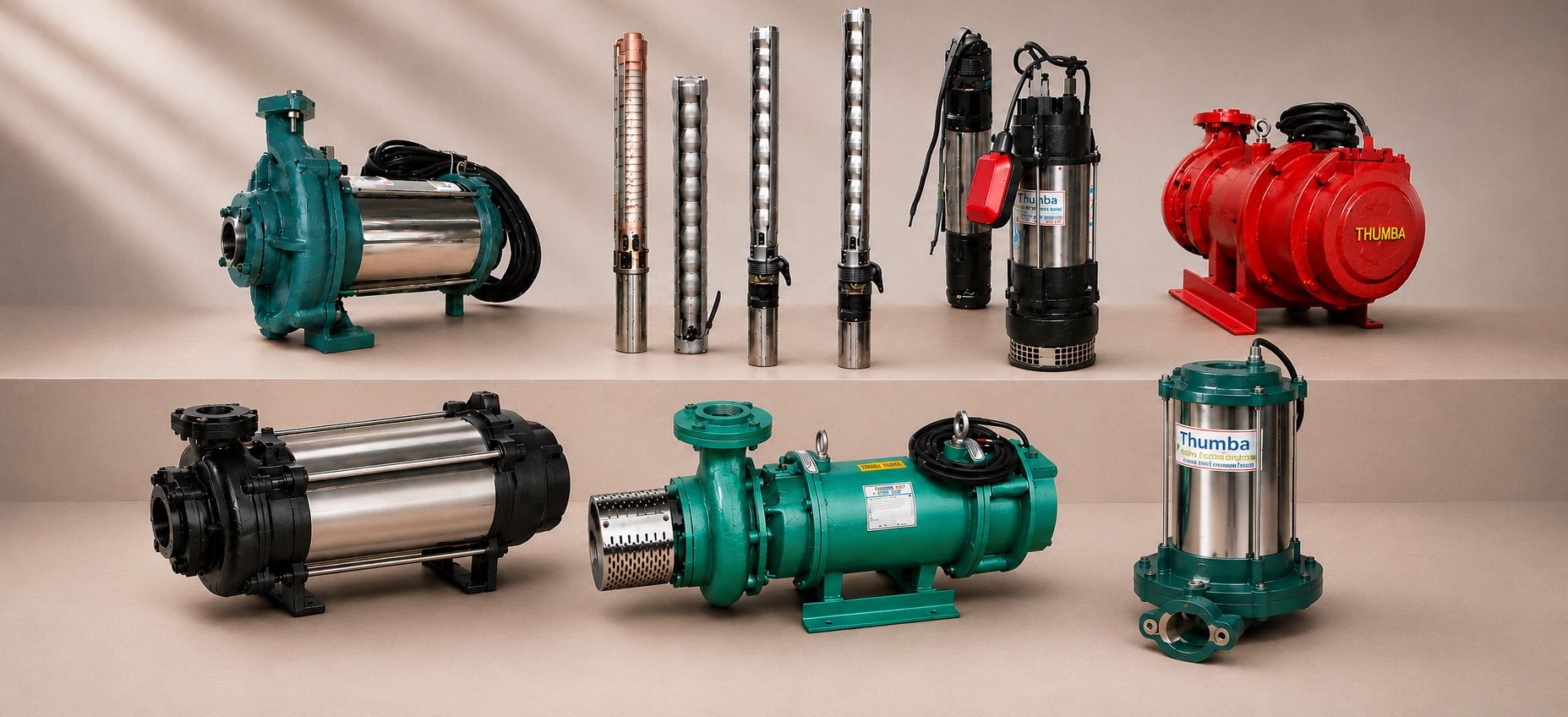
What is new in submersible pump technology, and how it got here — cast iron to stainless steel, solid castings to fabricated SS 304 impellers.
By Nallamuthu, mechanical engineer and founder, Thumba Agro Technologies, Palani
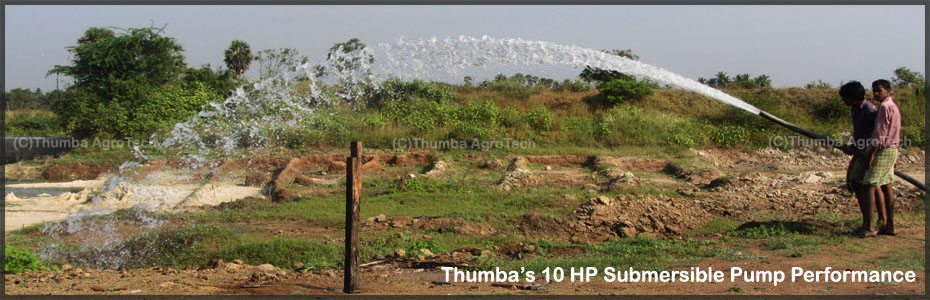
Submersible pumpset technology became popular in India and globally after 1980, as an update to the pumping sector, for one unique feature above all: static erection in deep open wells.
Before it, the motor had to be moved up and down as the water level in the open well rose and fell — the "bed level change" problem. A submersible pump sits still and simply works, and it performs better besides.
"Change is the only constant."
— Heraclitus
Introduced in India, working with open wells to a maximum of 100 ft depth.
Constructed with a cast iron body, cast iron impeller, MS shaft, copper winding and copper rotor design. It worked well.
But motor life was short — corrosion and voltage issues, because cast iron and MS are corrosive materials sitting in water. Even so, this design ruled the market up to 1995.
We erected our first submersible pumpset on our own farm in 1992 — on a 75 ft open well, irrigating a 20 acre groundnut farm.
Everything that follows on this page was learnt with our own money in our own field first.
Updates came in horizontal motor design and in the material of the motor core — silicon based — along with rotor design.
A few vertical motors with multiple impellers also entered the sector for high head applications. These were used mainly for long distance pipelines and RainGun sprinkler operations in farming.
Deep bore well motors also became very popular in this period, working up to 1,000 feet depth in drought areas.
1997 was a golden period for the pump set sector. Demand increased three to four times almost instantly, so manufacturers moved their production lines to fully automated factories, investing over ₹300 crore in factory infrastructure.
But the main fault was the material: they built all of it around cast iron bodies and MS shafts — corrosive in water.
Within a year the next update arrived — stainless steel (202) bodies and solid impellers. Having only just committed hundreds of crores to cast iron production units, an immediate second investment in new materials and technology was not possible.
Some new manufacturers started with stainless steel parts at some stages, but the established makers could not move. That is why the pumpset manufacturing sector went through a huge struggle in Coimbatore, South India — the biggest pumpset supplier to India and the world.
At the same time Gujarat, North India increased stainless steel pumpset production three to four times and introduced advanced features into the pumping sector. That is the reason it became difficult to compete with their quality and technology.
Solar powered AC pump sets came to market at 40% efficiency, against 27% for the older designs.
They used SS solid impellers, carbon bearings and high efficiency aluminium rotors.
Advanced sewage mud pumps for sewage and slurry pumping were designed in the same period. See also our solar agriculture pumpsets.
As a periodical advance, a new concept was introduced in pumpsets: "fabricated stainless steel impellers".
This completely changed the pumpset industry to the next generation of technology. As a mechanical engineer, I explain that update below.
Where we are today — explained in full in the next section.
The single change behind the 2026 generation of pumpsets, explained from an engineering point of view.
Solid stainless steel impellers are made from moulded solid SS castings, then machined to the required parameters — diameter, impeller gap and shaft hole.
Once all of that is finished, the impeller weighs far more than a noryl or gunmetal impeller. And when you use multiple impellers, that weight costs you: more power is needed just to run the pump.
Because of the high cost, manufacturers use SS 202 grade to make them. But SS 304 is the better option for impellers and bearings — and it is costlier still.
That cost problem is exactly why modern engineers developed the fabricated impeller.
It is nothing but polished SS 304 thin sheet, cut and folded to the required size and welded to form an impeller — with very minimum weight and good strength.
Because each impeller weighs so much less, you can use more impellers on the same power than you could with solid impellers. That is the whole point: performance and efficiency go up.
| Feature | Solid SS Impeller | Fabricated SS 304 Impeller |
|---|---|---|
| Made by | Moulded solid SS casting, then machined to diameter, impeller gap and shaft hole | Polished SS 304 thin sheet, cut and folded to size, then welded |
| Grade used | Usually SS 202, to hold the cost down | SS 304 — the better material for impellers and bearings |
| Weight | Much heavier than noryl or gunmetal impellers | Very minimum weight, with good strength |
| Impellers per motor | Fewer — each extra impeller demands more power | More impellers on the same power |
| Result | Workable, but efficiency is limited by weight and grade | Higher performance and efficiency |
As a great achievement in 2026, AC pumpsets with more than 60% performance have been released to market, and they will rule the market in future. Pumps giving 50 to 60 feet per stage — where the old design gave only 30 feet — have been released recently.
We use only this type of advanced pumpset for our projects.
Materials, impellers and what actually changed.
A fabricated impeller is made from polished SS 304 thin sheet, cut and folded to the required size and welded to form the impeller. A solid impeller is instead moulded as a solid stainless steel casting and then machined to diameter, impeller gap and shaft hole. The fabricated impeller has very minimum weight with good strength, so more impellers can be run on the same power than with solid impellers — which is what raises performance and efficiency.
The 1980 generation used a cast iron body, cast iron impeller, MS shaft, copper winding and copper rotor. It worked well, but cast iron and MS are corrosive materials in water, so motor life was short — corrosion together with voltage problems. That design still ruled the market until about 1995.
SS 304 is the better material for impellers and bearings, but it is costlier, so many manufacturers use SS 202 grade to control cost. The fabricated impeller is how modern engineers get SS 304 into the pump affordably — thin polished SS 304 sheet is cut, folded and welded rather than cast solid, which keeps both the material cost and the weight down.
Pumps giving 50 to 60 feet per stage have recently been released, against 30 feet per stage with the older design. Combined with the fabricated impeller, this is what allowed AC pumpsets with more than 60% performance to reach the market in 2026.
1997 was a golden period — demand rose three to four times almost instantly, and manufacturers moved to fully automated factories, investing over 300 crore rupees in infrastructure built around cast iron. Within a year the next update arrived: stainless steel 202 bodies and solid impellers. Having just committed to cast iron production units, most could not afford to change again, which is why the manufacturing sector went through a long struggle.
Solar powered AC pump sets reached the market around 2006 at about 40% efficiency, against 27% for the older designs. They used stainless steel solid impellers, carbon bearings and high efficiency aluminium rotors. Advanced sewage mud pumps for sewage and slurry pumping were designed in the same period.
Built with the technology described above — not the previous generation.
Tell us your bore well depth, water level and daily requirement — we'll design the pump set around it.
Get a Free Quote WhatsApp Us +91 98433 35703